Caernarfon wasn’t originally on our list. We ended up here almost by accident, during a small loop around the area on a day when the weather had turned bad enough that a few of our planned stops just weren’t going to be worth it. Caernarfon Castle became the fallback plan — and it turned out to be one of the better stops of the trip.
Caernarfon Castle: A Quick Overview
Caernarfon Castle is one of the great fortress-palaces built by King Edward I in North Wales, construction beginning in 1283 as part of his campaign to establish English control over the region. Unlike most medieval castles, it was designed with polygonal towers and banded stonework echoing the walls of Constantinople — a deliberate architectural statement rather than just a defensive structure. The whole undertaking, including the castle, the town walls, and a quay, took around 47 years to complete and reportedly cost the enormous sum of £25,000 at the time — a scale of investment that says a lot about how important this site was to Edward’s plans for Wales. The castle, together with the town walls encircling Caernarfon’s old town, forms part of a UNESCO World Heritage Site alongside the castles at Conwy, Beaumaris, and Harlech.
It’s also historically significant beyond its medieval origins: Caernarfon Castle was the site of the investiture of the Prince of Wales in both 1911 and 1969, and it houses the Royal Welch Fusiliers Museum, included with castle admission. Inside, you can climb several of the towers and walk sections of the walls, which gives a genuinely good sense of the scale of the place — it doesn’t feel like a small ruin you walk through in ten minutes. The castle is managed today by Cadw, the Welsh Government’s historic environment service.
Caernarfon Castle is managed by Cadw, and admission isn’t free. As of the 2026/27 winter season, adult tickets cost £14.90, with family tickets from £32.80 and free entry for under-5s and Cadw members. Prices are typically higher during the summer season (April to August), so treat this as a guide. Opening hours also shift with the seasons — roughly 9:30am to 5pm in spring and autumn, 9:30am to 6pm in July and August, and 10am to 4pm over winter, with last admission 30 minutes before closing. Booking online saves 5%, and it’s worth doing regardless since it guarantees entry. For the exact current prices and hours, check the official Caernarfon Castle page (Cadw).
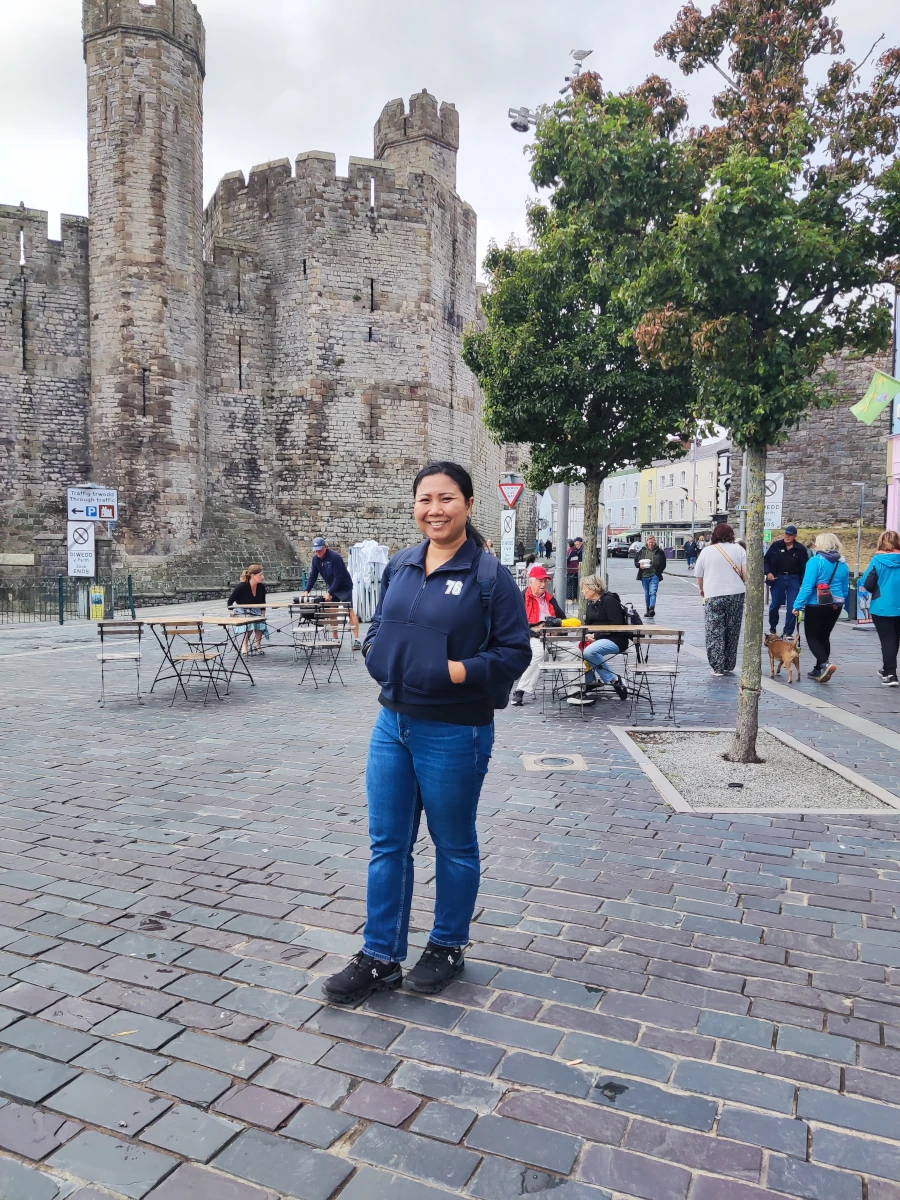
Caernarfon Castle Parking
Here’s the practical part: there’s a large car park directly at the castle and harbour, which sounds ideal — except it comes with a 2.1-metre height restriction, so anyone in a van or taller vehicle needs a plan B.
We parked instead a few hundred metres away at the Glan Môr Uchaf Car Park, which has no height restriction. Honestly, this worked out well rather than being a compromise — it meant walking in through Palace Street, one of the old town’s original medieval streets, rather than arriving straight into the car park by the castle.
Walking in Through Palace Street
Palace Street is one of the original streets laid out within Caernarfon’s town walls when Edward I had the settlement planned in the 13th century, alongside High Street, Church Street, and Northgate Street. It still follows the historic medieval grid, lined with old building plots and Grade II listed buildings, and it’s a genuinely nice way to get a first impression of the old town before you even reach the castle itself. If you have the choice, we’d actually recommend approaching this way rather than parking right at the entrance.
The Town Itself
Caernarfon’s old town is worth some time on its own, not just as a route to the castle. It sits within an almost fully intact set of medieval town walls — nearly half a mile of walls with eight towers and two gateways — and the cobbled Castle Square at its centre has shops, cafés, and pubs that make for an easy wander before or after visiting the castle. The square itself has been an open public space since the castle and walls were first built, and it’s flanked by statues of former Prime Minister Lloyd George and Sir Hugh Owen, a notable figure in the history of Welsh education.
It’s easy to underestimate how much of the medieval structure has survived here. Unlike a lot of historic town walls elsewhere in the UK that exist only in fragments, Caernarfon’s circuit is largely complete, and walking around it gives a real sense of how the whole town was originally laid out as a single planned settlement alongside the castle, rather than growing up around it later.
We’ve also captured a short clip of Caernarfon on video — worth a quick watch to get a feel for the town and castle before you go:

Final Thoughts
Caernarfon Castle wasn’t part of the original plan, but it ended up being exactly the kind of stop that makes a road trip worthwhile — genuinely impressive architecture, real history, and a walkable old town around it. If you’re driving anything larger than a standard car, sort out your Caernarfon Castle parking in advance and consider approaching via Palace Street, the way we did.
Frequently Asked Questions
How much does it cost to visit Caernarfon Castle?
As of the 2026/27 winter season, adult admission is £14.90, with a family ticket (2 adults, up to 3 children) at £47.70. Seniors and juniors get a reduced rate, under-5s go free, and Cadw members enter free. Prices are usually higher during the summer months, so check the official Cadw page for the current rate before you go.
Is there a 2-for-1 deal for Caernarfon Castle tickets?
Not as a standard offer from Cadw. The real ways to save are booking online (5% off), a Cadw membership (free entry), or discounts for Blue Light Card holders and HM Armed Forces personnel (10% off). If you’re visiting multiple Cadw sites, an Explorer Pass may work out cheaper than paying for each one separately.
What’s inside Caernarfon Castle?
You can climb several of the towers and walk sections of the walls, which gives a real sense of the castle’s scale. It also houses the Royal Welch Fusiliers Museum, included in your admission, plus an on-site exhibition. Note that the upper floors of the King’s Gate are currently closed while Cadw works on reopening them and reinstating lift access — worth checking the current status before you go if that’s a must-see for you.
How big is Caernarfon Castle?
It’s one of the largest castles in Wales. Along with the town walls and a quay, the whole complex took around 47 years to build and cost £25,000 at the time — a huge undertaking that reflects how important the site was to Edward I. Expect to spend at least an hour or two exploring properly, more if you also walk the town walls.
Nearby:
Once you’ve seen the castle, Black Rock Sands is an easy add-on nearby — a beach where you can drive right onto the sand rather than hauling your gear across a car park (see our Black Rock Sands guide). If you’re up for a walk instead, the Tre’r Ceiri hillfort on Garn Fôr is one of the best short hikes on the Llŷn Peninsula (see our Tre’r Ceiri walk guide).
Planning more of Wales? Check our Beddgelert guide, UK facts, and UK ETA guide before you go.
Watch the road trip
See Ireland from the driver's seat
Every stop on this blog is also on our YouTube channel — the drives, the detours and the van-life reality in between.
Subscribe on YouTube