Newquay is pretty much the first name that comes to mind when people think of Cornwall. They call it Surf City UK, and walking through the streets, it’s easy to see why: surf shops on every corner, wetsuits drying over balconies, and beaches that run right up against the town itself. On our Cornwall leg of the [[OVRTLND]] trip, Newquay was obviously on the list — even though we ended up driving away with mixed feelings.
Because as beautiful as Newquay’s setting is, the town is touristy, genuinely crowded on a good day, and its most famous beach, Fistral Beach, didn’t impress us nearly as much as two beaches a little further out. But let’s start from the beginning.
Newquay at a Glance
Newquay sits on Cornwall’s north coast and packs around eleven beaches into roughly eleven kilometres of coastline — a density you rarely find anywhere else on the English coast. The town itself is compact, easy to explore on foot, and offers a proper town centre with cafés, restaurants, shops, and pubs alongside its beaches. If you’re travelling by campervan, though, be prepared for crowds: Newquay is one of the most popular destinations in all of Cornwall, and you’ll notice it in the parking, the traffic, and on the beaches alike, especially during summer.
The Beaches of Newquay
Newquay markets itself on its eleven beaches, several of which sit right in town within easy walking distance. Here’s an overview of the best-known ones:
- Fistral Beach – Britain’s most famous surf beach, a wide sandy stretch with parking for around 200 cars (more info)
- Towan Beach – close to the town centre, sheltered, popular with families and beginner surfers
- Great Western Beach – right next to Towan Beach, joins up with the neighbouring beaches at low tide
- Tolcarne Beach – near the railway station, quieter than the main beaches
- Harbour Beach – the smallest beach, fully covered at high tide, sheltered and calm
- Lusty Glaze – privately run but open to the public, set in a natural amphitheatre of cliffs
- Porth Beach – on the eastern end of the bay, quieter, with rock pools and the small headland fort on Trevelgue Head
- Watergate Bay – just north of town, more details below
- Crantock Beach – south of Newquay, on the far side of the Gannel estuary
- Holywell Bay – known for its striking dunes, a little further out
- Perranporth Beach – our personal favourite, more details below
Here’s the catch: the exact reason Newquay packs so many great beaches into such a small area is also why it draws so many visitors. Fistral Beach in particular was so busy on the day we visited that whatever surfer vibe we’d hoped for was pretty much lost in the crowd. It’s a beautiful beach, no doubt — but for our taste it was too crowded, too commercial, and honestly not somewhere we wanted to linger.
Newquay Town Centre
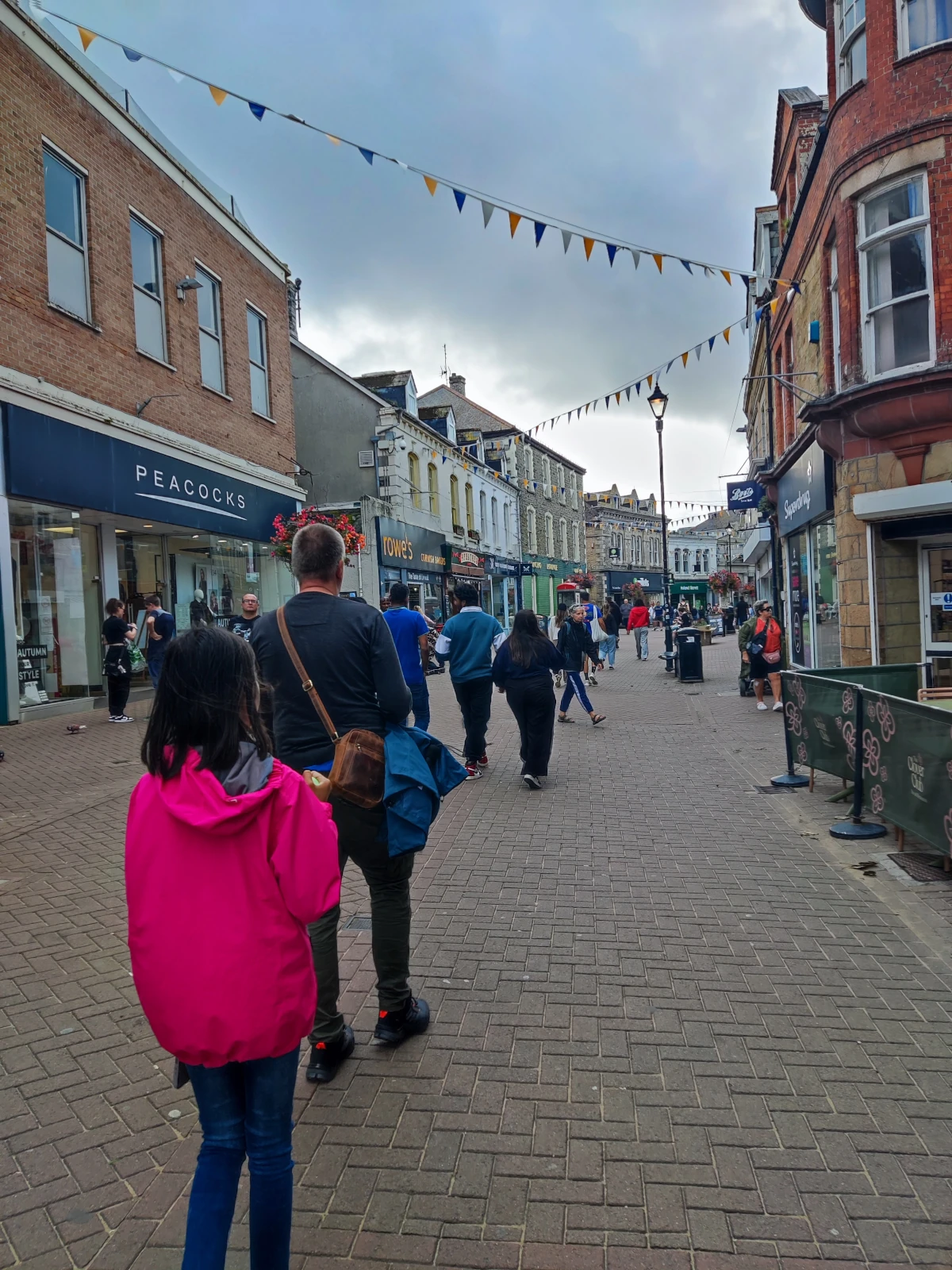
Unlike a lot of small coastal towns in Cornwall, Newquay actually has a town centre worth spending time in — more than just two souvenir shops and a fish-and-chip stand. Around Bank Street and Fore Street you’ll find cafés, restaurants, surf shops, and small boutiques lined up one after another. It’s lively, often loud, and that’s exactly what gives it its charm — Newquay has an energy you won’t find in Cornwall’s quieter towns.
What to Do on a Rainy Day
Cornwall wouldn’t be Cornwall without the occasional rainy day thrown in. Newquay actually has more to offer here than most of the smaller towns along the coast:
- Newquay Zoo – set in Trenance Gardens park, home to a wide range of animals, great for a full family day out
- Blue Reef Aquarium – right on the promenade above Towan Beach, with a walk-through underwater tunnel and Omiros the rescued sea turtle as the star attraction; open year-round (check opening hours)
- Various indoor options around town, including bowling, escape rooms, and cinemas
So if you get stuck with a rainy day in Newquay, you’re far from out of options — unlike in many of the smaller towns nearby.
Perranporth Beach: Our Real Highlight
A little south of Newquay, roughly a 15–20 minute drive or about 11 kilometres away, lies Perranporth. And honestly, this beach won us over far more than Fistral Beach ever did in Newquay itself.
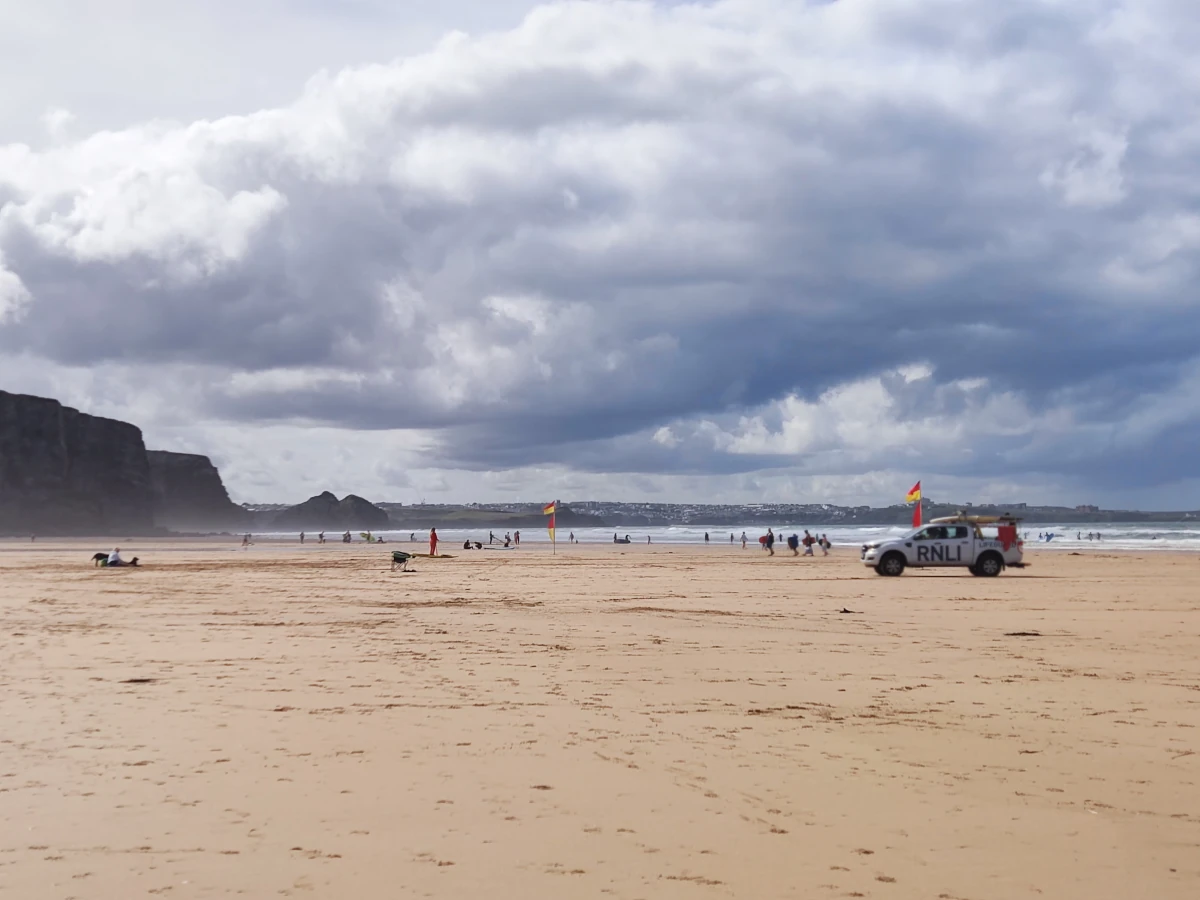
Perranporth Beach is huge — at low tide the sand stretches for several kilometres — and yet it felt noticeably more relaxed than Newquay’s main beaches. The beach is backed by dunes, there’s a natural rock arch at Droskyn Point with great views over the bay, and even on a busy day we found plenty of room to breathe without constantly weaving between towels.
Parking note for campervans: Right at the southern end of Perranporth there’s a car park that’s unfortunately height-restricted to 2.1 metres — off-limits for most vans. Most of the other car parks closer to the village and beach (Droskyn Car Park, for example) are also height-restricted. The only car park we found without a height restriction was Wheal Leisure Car Park (details via Cornwall Council). From there it’s just a short walk to both the beach and the village centre — our clear recommendation if you’re driving anything taller than a standard car.
Watergate Bay: Also Worth the Trip
Another beach that genuinely impressed us is Watergate Bay, just a few minutes north of Newquay. It’s a wide, long stretch of sand and a popular spot for kitesurfing and land yachting when the wind’s offshore — plenty of space and openness, even when it gets busy.

Parking note: The main car park right at Watergate Bay is also height-restricted. Directly across the road, though, there’s a large, open car park that’s suitable for campervans too. We’d actually prefer this one even in a regular car, since it’s far more spacious and nowhere near as tight as the beach car park itself.
Our Verdict on Newquay
Newquay is undeniably a key stop on any Cornwall road trip — it has a genuine town centre, plenty to do on rainy days, and Fistral Beach is one of Britain’s most famous surf beaches. Still, for us, the real highlight of this leg wasn’t Newquay itself, but the two beaches just outside it: Perranporth, with its endless sand and more relaxed atmosphere, and Watergate Bay, with its wide-open space and the far more comfortable parking option across the road.
Our recommendation: use Newquay as a base, take in the town centre and, if you’re up for it, the zoo or aquarium — but spend your actual beach time in Perranporth or Watergate Bay instead.
Read more from our England leg in our posts on Woolacombe Beach in North Devon and Black Rock Sands in Wales.
A selfie taken on the beach at Watergate Bay, Cornwall, with a striking natural rock arch carved into the cliffside in the background.
Planning a UK road trip? Check our UK facts, UK ETA guide, and van life navigation tips before you go.
Watch the road trip
See Ireland from the driver's seat
Every stop on this blog is also on our YouTube channel — the drives, the detours and the van-life reality in between.
Subscribe on YouTube