Every time we head for the UK or Ireland, this is the Germany to Calais route we fall back on. We’re based in Bavaria, somewhere between Frankfurt and Würzburg, and after doing this drive enough times, we’ve settled on a version that works — reliable stops, no unnecessary detours, and a routine that accounts for the one thing that’s bitten us before: border queues at Calais. The same route also covers a drive from Germany to Dunkirk, if that’s the crossing you’re heading for instead — the roads only split right at the very end.
The Route: Bavaria to the Belgian Border
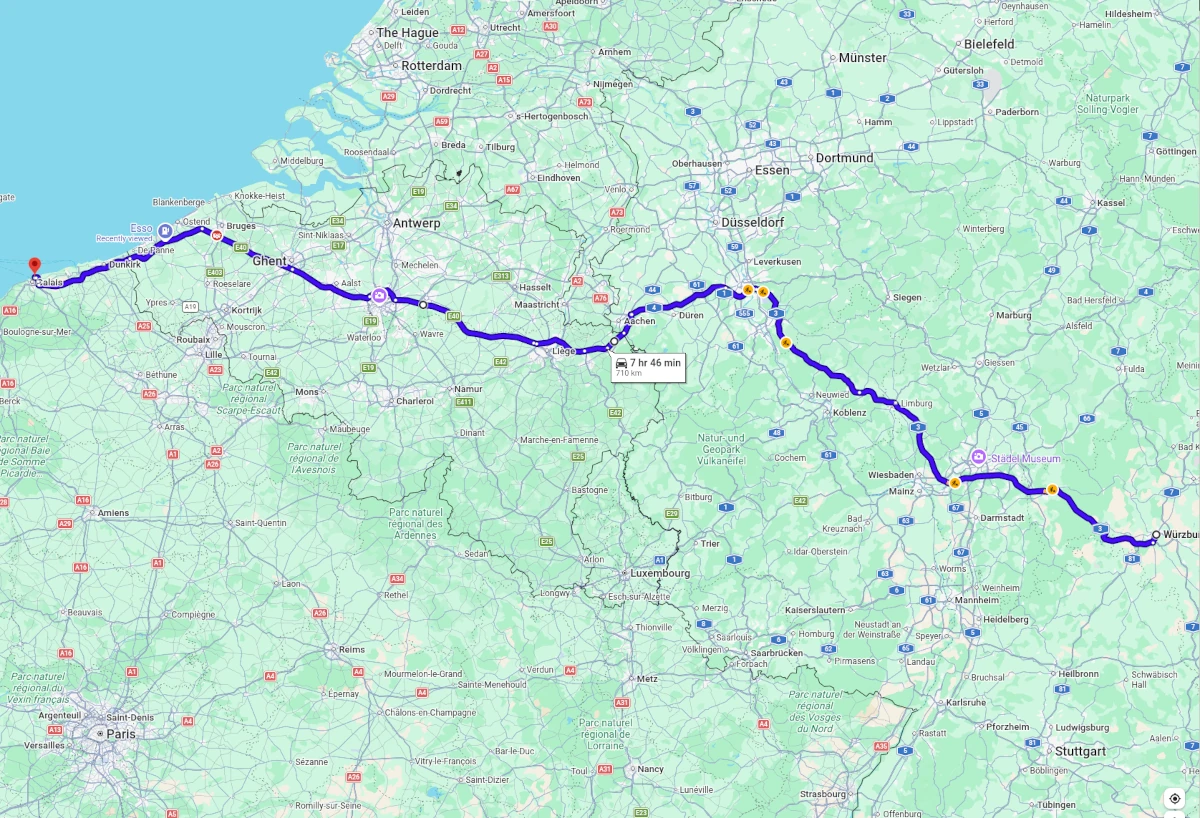
From our starting point, the route runs like this:
- A3 past Frankfurt, heading toward Cologne.
- Before Cologne, switch onto the A4 toward Aachen.
- Just before Aachen, we come off at Eschweiler West — roughly the halfway point of the whole drive.
- From there, continue a short stretch further on the A4, then straight onto the A44 toward Brussels.
- The A44 becomes the E40 once you cross into Belgium, and you follow the E40 around Brussels toward France.
- Just before the French border, near Nieuwpoort, we take a short second break.
- After crossing into France, it’s a short final stretch to either Calais or Dunkirk.
Two stops, both with a purpose — not just wherever happens to be convenient at the time.
Stop 1: Eschweiler West
This is roughly the halfway mark of the whole drive from Bavaria, and it’s where we usually refuel. There are petrol stations and well-known fast food chains here, so it works well as a proper break — food, fuel, and a stretch of the legs.
There’s also an alternative a few hundred metres further along the A4: the Aachener Land service station. We’d flag this one with a caveat — it’s priced like a typical Autobahn Raststätte, meaning fuel is noticeably more expensive, McDonald’s charges a markup compared to the regular menu, and even using the toilet costs money. Eschweiler West is the better value stop in our experience, and it’s the one we default to.
Stop 2: Just Before the French Border, Near Nieuwpoort
The second stop is shorter and more functional — usually just a toilet break and a coffee, not a full pause. What makes it a fixed part of our route rather than an optional extra is Calais itself: we’ve had genuinely long waits at check-in and passport control there more than once. If you want to check conditions before you go, ADAC’s live traffic map shows current border and route conditions along the way. Taking this last break before the border means we go into that queue rested and not desperate for a bathroom, rather than adding stress on top of an already unpredictable wait.
After the Border: On to Calais or Dunkirk
Once you’re through the French border, it’s a short final stretch to either Calais — for the Eurotunnel or ferry — or Dunkirk, if you’re catching a ferry onward to the UK or Ireland from there instead. If your plan is specifically to drive from Germany to Dunkirk, the route stays identical right up until this final stretch, where you simply continue past the Calais turn-off. We’ll cover both of those legs, including specific operators and terminal routes, in dedicated posts down the line — this one is really about the drive that gets you there.
Why This Route Works for Us
Nothing about this route is exotic — it’s mostly straightforward Autobahn and motorway driving through Germany and Belgium. What makes it work is the structure: one substantial stop at the halfway point for fuel and food at sensible prices, and one short, deliberate stop right before the part of the journey that’s historically given us the most grief. If you’re doing this drive regularly, having fixed stops you know and trust beats improvising a new one every time.
One small practical note: Google Maps usually suggests a different route than the one above, so we don’t rely on it here. We’ve found ViaMichelin’s route planner tends to match our preferred roads more closely if you want to double-check the route yourself. Instead, we save our preferred route in the TomTom Plan app, which lets us keep it stored and ready rather than re-plotting it every time.
A Note on Planning the Crossing Itself
Once you’re at Calais or Dunkirk, there’s a separate set of decisions to make — Eurotunnel versus ferry, which operator, and whether an overnight crossing makes sense for your schedule. We’ve written about a lot of this already: our full comparison of Ferry vs. Eurotunnel, what we learned the hard way in The Night Ferry Mistake, and the broader picture in our UK and Ireland ferry crossings guide. If you’re still working out your in-van navigation setup for a trip like this, our van life navigation guide covers what’s worked for us.
Driving From Calais to Germany
If you’re coming the other way — off the ferry or out of the Eurotunnel at Calais and heading into Germany — it’s simply this route in reverse, and the same two stops still make sense on the way back. From Calais, you’ll pick up the E40 past Brussels, join the A44 toward Aachen, and rejoin the A4/A3 corridor into Germany from there.
Depending on where in Germany you’re headed, the drive from Calais looks roughly like this:
- Calais to Cologne: the shortest leg of the reverse route, and the point where most drivers heading further into Germany will branch off.
- Calais to Frankfurt: follow the same A4/A3 corridor past Cologne, continuing on toward Frankfurt.
- Calais to Stuttgart or Calais to Munich: expect a longer day — from Frankfurt you’ll continue south, and this is where planning a proper break (not just our two standard stops) starts to matter.
- Calais to Berlin or Calais to Hamburg: these branch off well before our usual Bavaria-bound route, so treat this guide as a starting point for the first half of the drive rather than the full route.
Whichever direction you’re driving, our advice from the Bavaria-to-Calais route still applies: fuel and food at Eschweiler West rather than Aachener Land, and a proper break before or after the Calais border crossing rather than pushing straight through.
Final Thoughts
This Germany to Calais route from Bavaria isn’t complicated, but having it dialled in — including exactly where we stop and why — takes a lot of the guesswork out of what’s otherwise a long driving day. If you’re doing a similar run from Germany, whether toward Calais or on a drive from Germany to Dunkirk instead, we’d recommend building in the same kind of buffer before the French border: it’s saved us more than once.
Planning the rest of your UK or Ireland trip? Check our UK ETA guide and UK facts before you go.
Watch the road trip
See Ireland from the driver's seat
Every stop on this blog is also on our YouTube channel — the drives, the detours and the van-life reality in between.
Subscribe on YouTube