After watching the sun come up over St. Helens Pier, our very first proper stop in Ireland was Duckett’s Grove in County Carlow — and it turned out to be a genuinely memorable way to start exploring the country. A roofless Gothic mansion rising out of open farmland, restored walled gardens, and a local legend that’s followed the place for generations. Here’s everything worth knowing before you go.
What Duckett’s Grove Actually Is
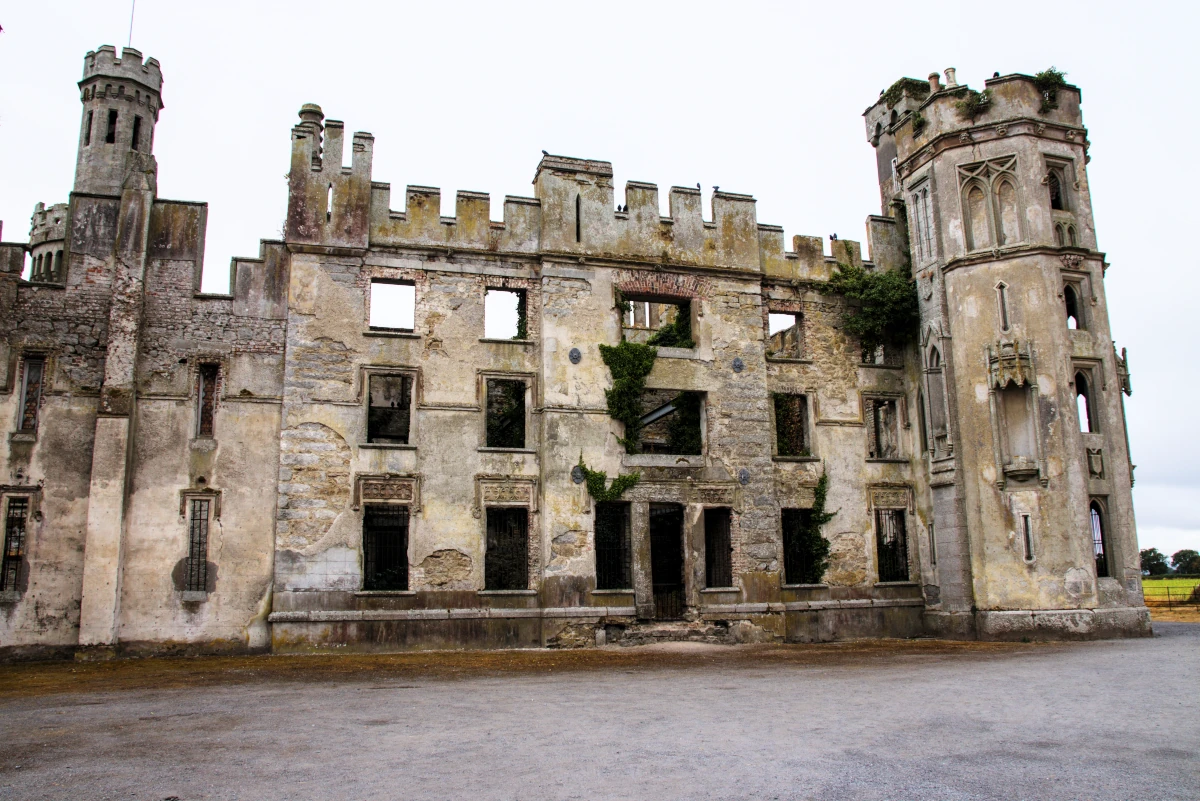
Duckett’s Grove is the ruined shell of a once-grand country house, standing on what used to be a vast estate in rural County Carlow. The house itself is roofless and can’t be entered, but its towers, turrets, and elaborate stonework are still standing, and the grounds around it — including two restored walled gardens — are freely open to explore. It’s a striking, slightly eerie sight the moment it comes into view across the surrounding fields, and honestly, a great first taste of Ireland’s mix of history and atmosphere.
The History Behind Duckett’s Grove
The Duckett family first built a house on this site in the mid-1700s, when they were among the largest landowners in County Carlow, with an estate that once stretched to tens of thousands of acres. What started as a relatively modest Georgian house was transformed in the 1830s, when the family had it remodelled into the elaborate Gothic Revival style whose ruins still stand today — towers, turrets, arched windows, and decorative stonework designed to project wealth and status.
The family’s fortunes didn’t last, though. Over the following decades, the estate gradually declined, and the house itself was gutted by a fire in the early 1930s, destroying the interior completely and leaving only the stone shell we see now. The land changed hands several times over the following decades until Carlow County Council acquired the estate in the mid-2000s. Since then, the council has restored the two walled gardens behind the house and opened the grounds to the public, turning what could have been a forgotten ruin into one of the county’s better-known visitor spots.
The Legend of the Duckett’s Grove Banshee
No visit to Duckett’s Grove is really complete without hearing about the story that’s followed the estate for generations — and it’s a big part of why the place has such a reputation locally.
According to local legend, William Duckett, one of the estate’s owners, was involved in a relationship with a young local woman. The story goes that she was killed in a riding accident on the estate grounds, and in her grief, her mother placed a curse — known in Irish folklore as a piseóg — on William, his family, and the property itself. The curse was said to bring misfortune, financial ruin, and death, and locals connected it directly to the family’s eventual decline and the fire that later destroyed the house.
From that point on, the estate became associated with a banshee — a wailing female spirit from Irish folklore said to appear or be heard before a death. Visitors and locals over the years have reported hearing unexplained cries around the ruins, along with other strange occurrences: mysterious lights, shadowy figures, the sound of a phantom horse and carriage, and sightings of a woman in white wandering the grounds, said by some to be the ghost of the young woman at the centre of the story. The site has even drawn attention from paranormal investigators and TV crews over the years, further cementing its reputation as one of Ireland’s more notably haunted ruins.
Whether or not you put any stock in the legend, it’s hard not to feel the atmosphere a little more once you know the backstory — the empty windows and looming towers take on a slightly different character once you’re standing in front of them.
What There Is to See and Do
Beyond the ruin itself, the main draw at Duckett’s Grove today is the pair of restored walled gardens behind the house. These have been brought back to a genuinely well-kept state, with planted beds, pathways, and a completely different atmosphere to the dramatic ruin out front — a nice contrast between decay and careful restoration within the same visit. The grounds are large enough to spend a proper hour or more wandering, and the site also hosts occasional events and markets throughout the year, so it’s worth checking what’s on if you’re planning a visit around a specific date.
Duckett’s Grove from Above: Our Drone Footage
Duckett’s Grove: 🎥 We flew our drone over Duckett’s Grove – watch the footage from 2:17.
Or watch the full video of our first day in Ireland, from the ferry at sunrise to our arrival in Lisacul.

Practical Information for Visiting
Here’s the part that made Duckett’s Grove such an easy first stop for us: it’s genuinely low-effort to visit.
- Parking is free. There’s no charge to leave your car (or van) while you explore.
- There’s no entry fee. The grounds and gardens are open to the public at no cost.
- A toilet is available on site, which is a small but genuinely useful thing to know after an early ferry arrival and a stop at a car park with none.
- There’s a small shop on site as well, worth a quick look if you want a snack, a drink, or a souvenir before moving on.
For a location with this much history and atmosphere, the complete lack of admission cost or parking fees makes it a genuinely easy addition to any County Carlow itinerary — you can drop in for twenty minutes or spend a couple of hours without it affecting your budget either way.
The site is owned and managed by Carlow County Council, so if you want to double-check anything before you go — accessibility, upcoming events, or seasonal opening times for the gardens — their office is the best point of contact.
Frequently Asked Questions
Is there an entry fee for Duckett’s Grove? No. Access to the ruin, the grounds, and both walled gardens is completely free.
Is parking free at Duckett’s Grove? Yes, there’s a free car park on site with no charge to leave your vehicle while you explore.
Can you go inside the Duckett’s Grove house? No. The house is roofless and structurally a ruin, so entry into the building itself isn’t possible. You can walk right up to and around it, though, and explore the grounds and walled gardens freely.
Is Duckett’s Grove haunted? Local legend says so. The estate is associated with a banshee tied to the story of William Duckett, and generations of visitors and locals have reported unexplained cries, sightings, and other strange occurrences around the ruins — enough that the site has drawn interest from paranormal investigators over the years.
Are there toilets and a shop on site? Yes, both a toilet and a small shop are available on site, which is handy if you’re stopping in as part of a longer day of driving.
Why It Was the Perfect First Stop
We hadn’t planned Duckett’s Grove as some kind of symbolic start to our Irish road trip, but looking back, it worked out that way. Coming straight from a quiet, practical stop at St. Helens Pier — coffee, waiting for daylight, nothing more — arriving at a genuinely dramatic Gothic ruin with centuries of history and a proper local legend attached felt like exactly the right way to properly begin exploring Ireland. It’s free, it’s easy to get to, and it gives you a real sense of the country’s layered history within the first hour of driving.
Final Thoughts
Duckett’s Grove is one of those places that punches well above what you’d expect from a free, no-fuss visitor stop. The ruined house alone is worth the detour for the atmosphere, the banshee legend adds a genuinely good story to tell afterward, and the restored walled gardens give you something calmer to balance it out. If you’re road-tripping through County Carlow — or, like us, looking for a first proper Irish landmark to kick off a longer trip — it’s hard to think of a better, more effortless choice.
Plan your own trip
What we used on our Ireland road trip
📶 Mobile data
We used a local Three SIM — an eSIM is the easiest alternative if you want data from the moment you land. Get an Ireland eSIM from Airalo
🚁 Our drone
Most of our aerial shots were filmed with the Potensic Atom 2. Check the current price on Amazon
Some of these are affiliate links. If you book or buy through them, we may earn a small commission at no extra cost to you. It helps us keep the road trip — and this blog — going.
Watch the road trip
See Ireland from the driver's seat
Every stop on this blog is also on our YouTube channel — the drives, the detours and the van-life reality in between.
Subscribe on YouTubeOur Ireland road trip, stop by stop
← Previous stop: St Helen’s Pier, our first sunrise in Ireland
Next stop → Brownshill Dolmen, the heaviest capstone in Europe
🗺️ See every stop on our interactive Ireland road trip map.
Planning your own Ireland road trip? Check our St. Helens Pier post, our Dunkirk to Rosslare ferry review, and our Ireland facts before you go.