Just a short drive from Duckett’s Grove, which we’d visited earlier that day, sits one of Ireland’s most impressive prehistoric sites: the Brownshill Dolmen. There’s a small car park right off the road, and from there it’s a short walk of under five minutes to the dolmen itself.
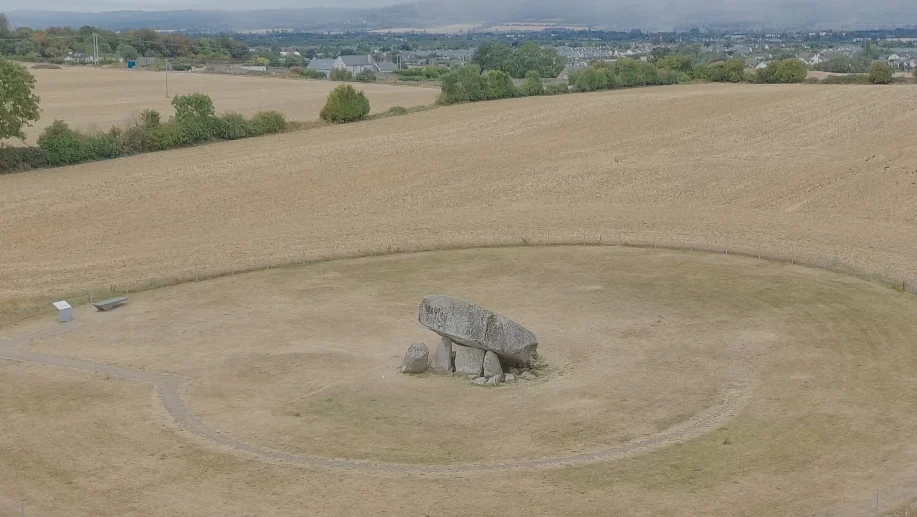
What Makes the Brownshill Dolmen So Special
The Brownshill Dolmen (also known as the Kernanstown Portal Tomb) is topped by a granite capstone estimated at around 150 tonnes — reputed to be the heaviest capstone of its kind in Europe. To put that in perspective, it’s roughly the weight of more than 20 fully grown elephants, all resting on just three comparatively slender supporting stones. The sheer scale is impressive enough on its own, but knowing that people raised this monument thousands of years ago with nothing but basic tools makes it even more remarkable.
History and Age
The dolmen is thought to have been built somewhere between 4000 and 3000 BC, making it one of the oldest surviving man-made structures in Ireland — older than the pyramids of Giza. As a portal tomb, it likely served as a burial chamber or ceremonial site during the Neolithic period. Its distinctive portal stones flank a door stone, and the massive capstone slopes downward to the west, where it rests on a lower boulder. A fourth stone standing a little apart from the main structure may be the remains of a forecourt. The site has never been excavated, which means much of its original purpose remains a mystery.
The Brownshill Dolmen is officially listed as a National Monument of Ireland (reference No. 613) and is in public ownership. You can find more background on the official Carlow Tourism page.
Size and Dimensions
For scale, here are the key measurements:
- Height: around 3.5 metres
- Length: around 6.1 metres
- Width: around 4.7 metres
- Capstone weight: roughly 150 tonnes
It’s this combination of size and sheer weight that sets the Brownshill Dolmen apart from other portal tombs in Ireland and across Europe.
See the Brownshill Dolmen on video
Photos don’t really show how massive the capstone is.
Brownshill Dolmen: 🎥 See the dolmen’s massive capstone on video – watch from 4:59.
Or watch the full video of our first day in Ireland, from the ferry at sunrise to our arrival in Lisacul.

Getting There and Parking
The Brownshill Dolmen sits just a few kilometres east of Carlow Town, directly off the R726 (Hacketstown Road), and is clearly signposted and visible from the road. There’s a small car park right at the roadside (Google Maps link), and from there it’s under a five-minute walk to reach the dolmen. The path is straightforward, making it an easy stop even if you’re short on time.
Practical Information
Visiting the Brownshill Dolmen is just as low-effort as Duckett’s Grove: free access, no entry fee, and you won’t need more than 15–20 minutes for the whole stop, parking and walk included. If you’re travelling between Carlow Town and Hacketstown, or the other way around, it’s well worth the small detour.
Final Thoughts
The Brownshill Dolmen is one of those places that looks unassuming from a distance, but once you’re standing in front of it, the scale of what Neolithic builders achieved really sinks in. Paired with nearby Duckett’s Grove, it makes for a perfect, effortless double stop for anyone exploring County Carlow on an Ireland road trip.
Plan your own trip
What we used on our Ireland road trip
📶 Mobile data
We used a local Three SIM — an eSIM is the easiest alternative if you want data from the moment you land. Get an Ireland eSIM from Airalo
🚁 Our drone
Most of our aerial shots were filmed with the Potensic Atom 2. Check the current price on Amazon
Some of these are affiliate links. If you book or buy through them, we may earn a small commission at no extra cost to you. It helps us keep the road trip — and this blog — going.
Watch the road trip
See Ireland from the driver's seat
Every stop on this blog is also on our YouTube channel — the drives, the detours and the van-life reality in between.
Subscribe on YouTubeOur Ireland road trip, stop by stop
← Previous stop: Duckett’s Grove, a Gothic ruin with walled gardens
Next stop → Three Ireland prepaid SIM, the Super Surfer plan we used
🗺️ See every stop on our interactive Ireland road trip map.
📷 The aerial shots in this post were taken with our drone. Read our Potensic Atom 2 review after weeks in Ireland.
Planning your own Ireland road trip? Check our Duckett’s Grove post, our St. Helens Pier post, and our Ireland facts before you go.