After the wind and drizzle at Coumeenoole Beach, we only drove a few minutes further along the coast before stopping again at Clogher Head Dingle, a small headland on the Slea Head Drive that is also known by its Irish name, Ceann a’ Chloichir. It turned out to be one of those quiet stops that stays with you: a short, easy walk up and a Blasket Islands view that makes you feel like you are standing right at the edge of Europe. In this post we cover where Clogher Head is, where we parked our van (there is no real car park), how long the walk takes, what you can see from the top and whether it is worth the stop.
Clogher Head at a glance
- LocationSlea Head Drive (R559) between Dunquin and Ballyferriter, Dingle Peninsula, Co. Kerry
- ParkingNo proper car park; we parked at the roadside a few hundred metres away
- Entry feeFree
- WalkShort, gentle climb; no hiking boots or special fitness needed
- Time neededAbout 40 minutes, including parking, the walk and the view
- FacilitiesNone
- Van-friendly?Yes with our Tourneo Custom, if you park considerately
- Worth it?Yes, especially if you are already driving the Slea Head Drive
Where Is Clogher Head on the Dingle Peninsula?
Clogher Head sits on the far western tip of the Dingle Peninsula in County Kerry, on the stretch of the Slea Head Drive that runs north from Dunquin towards Ballyferriter. If you follow the loop the way visitors are asked to, clockwise from Dingle through Ventry, you reach it shortly after Slea Head, Coumeenoole and Dunquin. The local tourism site for the Slea Head Drive asks visitors to stick to that direction and to follow the road signs rather than the sat nav, because the road is only meant to be two-way for residents.
You can find the headland on this spot on Google Maps. It is not a big, signposted attraction with a visitor centre. It is simply a rocky headland next to the road, and that is a big part of its charm.

Parking at Clogher Head: There Is No Real Car Park
This was the one thing we did not like. There is no proper car park right at the headland. We left the van at the side of the road a few hundred metres away, at this roadside spot, and walked the rest.
With our Ford Tourneo Custom that worked fine, but the road here is narrow and busy with Slea Head Drive traffic in season. If you stop, make sure you are fully off the carriageway and not blocking a gate, a farm entrance or anyone else who needs to get past. A bigger motorhome will find it harder to tuck in at the roadside.
If you would rather use a marked car park, there is a small free one above Clogher Strand, the little beach just north of the headland. Discover Ireland lists it as free parking and the start of a short cliff-top walk. We did not use it ourselves, so we cannot tell you how busy it gets. Reports about overnight parking there are mixed, so check the signs on the day rather than relying on old app reviews.
The Walk Up Clogher Head: How Long Does It Take?
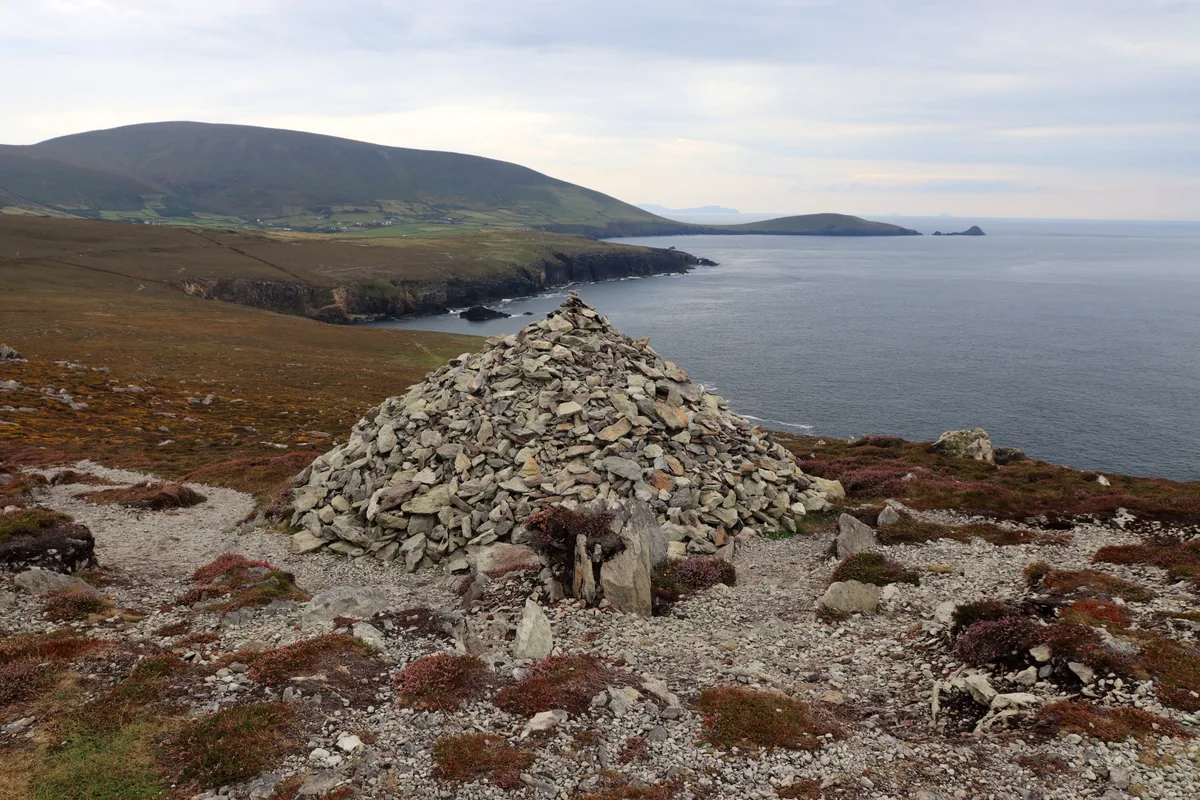
The path up to the headland is a gentle climb. You do not need hiking boots, and you do not need to be particularly fit. With every few steps the view opens up a bit more, which makes the short climb feel even shorter.
For the whole detour, meaning parking, walking up, enjoying the view and walking back to the van, plan about 40 minutes. That is what it took us, and we did not rush at the top.
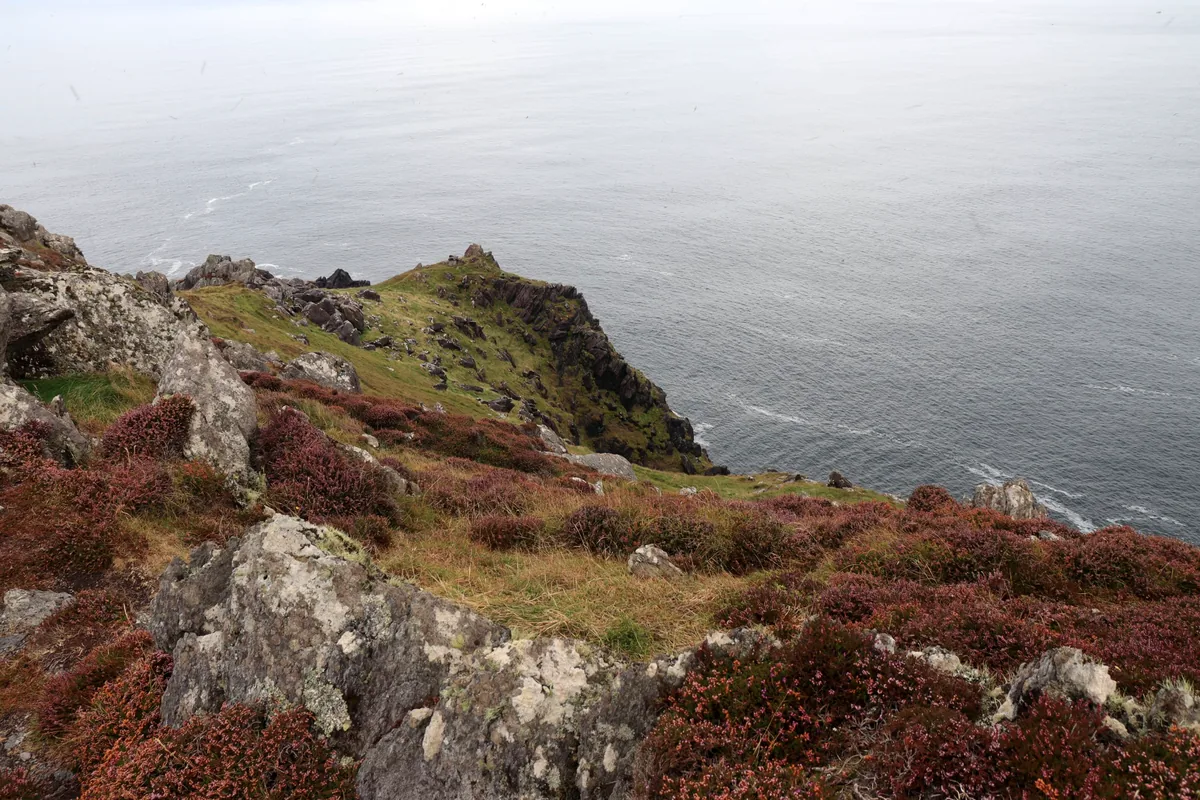
On the highest point there is a pile of stones, a kind of cairn marking the summit, which gives the place a slightly wild, old feel. The headland is not high; the Irish Times puts a spot height on its rocky ridge at around 115 metres. But the cliffs drop straight into the Atlantic, so keep a sensible distance from the edge, especially in wind.
The Blasket Islands View From the Top
The view is the reason to come, and it was the thing we liked most. From the top you look out over the Atlantic, the jagged coastline below you and the Blasket Islands out at sea. We just stood there for a while and looked. It is one of those places where you really feel that you are standing at the very edge of Europe.
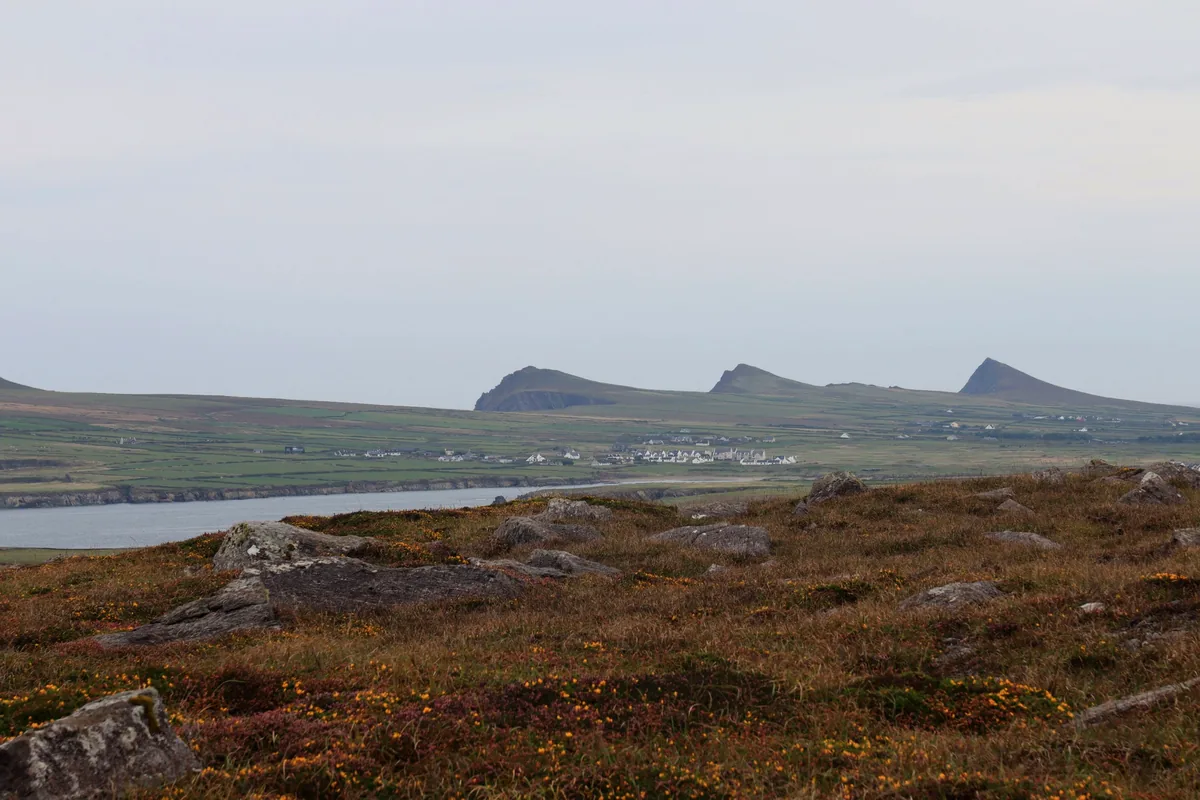
The island that catches the eye from this part of the coast is Inis Tuaisceart, the most northerly of the Blaskets. Locals call it An Fear Marbh, the Dead Man, and you will also see it called the Sleeping Giant, because its outline looks like a figure lying on its back in the water. Looking north, you also see Ceann Sibéal (Sybil Head) and the Three Sisters, the three peaks above the coast near Ballyferriter.

Clogher Head and Star Wars
Clogher Head is not itself a film set, but it is one of the best places to look at one. The Dingle Peninsula film location trail describes it as a great viewing point for Ceann Sibéal, the headland where scenes for Star Wars: The Last Jedi were filmed. The set was removed after filming and the site is on private farmland, so a viewpoint like Clogher Head is the way to see it. The same trail also links the area to Ryan’s Daughter and Far and Away.
Best Time to Visit Clogher Head
We visited on a day with a lot of rain. We were lucky: right when we were at Clogher Head, the weather cleared for a while and we had a short window of sunshine. That made a huge difference, because the whole point of this stop is the view.
So our advice is simple: go when you can see the islands. On the Dingle Peninsula the weather changes fast, so if you are driving the loop on a mixed day, keep an eye on the sky and stop here when it brightens up. In rain or low cloud you will see much less from the top, and the wind on an exposed headland like this can be strong.
Is Clogher Head Worth Visiting?
Yes. It is a small, unspectacular stop in the best sense: no ticket, no queue, no visitor centre, just a short walk and a huge view. If you are already driving the Slea Head Drive, it is an easy 40-minute detour that rewards you far more than the effort it takes. It is not a place we would drive to on its own from far away, but as part of the loop it is one of the stops we would not skip again.
Our Honest Takeaway
Clogher Head is worth it. The view over the Atlantic and the Blasket Islands is the highlight, the walk is easy and it costs nothing. The only real downside is parking: there is no proper car park, so you end up at the roadside. If you stop here, take a moment to park properly and make sure you are not getting in the way of other drivers, residents or farm traffic. Do that, and this is one of the nicest short stops on the Slea Head Drive.
Our Clogher Head stop on video
A short climb above the Slea Head Drive – here’s how the view over the Blasket Islands looked.
Clogher Head: 🎥 Blasket Islands view – watch from 12:43.
Or watch the full video of our day on the Dingle Peninsula: the intro, Fermoyle Beach, Conor Pass Waterfall and Peddler’s Lake, the Conor Pass drive, Coumeenoole Beach and Dingle Town. Right after Clogher Head we stopped in Dingle Town.

Clogher Head Dingle FAQ
Where is Clogher Head in Kerry?
Clogher Head is on the western tip of the Dingle Peninsula in County Kerry, on the Slea Head Drive (R559) between Dunquin and Ballyferriter. If you drive the loop clockwise from Dingle, you reach it after Slea Head, Coumeenoole Beach and Dunquin.
Is there parking at Clogher Head?
There is no proper car park at the headland itself. We parked at the roadside a few hundred metres away and walked up. There is also a small free car park above Clogher Strand just north of the headland. Wherever you stop, park fully off the road and do not block gates or other traffic.
How long is the walk up Clogher Head?
The climb is short and gentle. For the whole stop, including parking, walking up, enjoying the view and walking back, plan around 40 minutes. You do not need hiking boots or special fitness.
What can you see from Clogher Head?
From the top you see the Atlantic, the rugged coastline and the Blasket Islands, including Inis Tuaisceart, known as the Dead Man or Sleeping Giant. Looking north you also get a great view of Ceann Sibéal (Sybil Head) and the Three Sisters.
Is Clogher Head a Star Wars location?
Not directly. Clogher Head is a viewing point for Ceann Sibéal, the nearby headland where scenes for Star Wars: The Last Jedi were filmed. The filming site itself is on private land, so viewpoints like Clogher Head are how most visitors see it.
Can you visit Clogher Head with a campervan?
Yes. We stopped with our Ford Tourneo Custom without problems, but there is no dedicated parking, so you need to find a safe spot at the roadside. Larger motorhomes will find it harder. Follow the clockwise one-way direction of the Slea Head Drive.
The Van Kit We Rely on at Roadside Stops
Stops like Clogher Head mean leaving the van at the side of a narrow road and walking away from it for a while, after driving the tight, one-way stretches of the Slea Head Drive. When we leave the van parked, we add this KRASER steering wheel lock as an extra, visible deterrent. It is not a guarantee against theft, but it is a simple habit that makes us feel better at unattended roadside spots. For the drive itself, in our Ford Tourneo Custom we use the Wolfbox G900 Pro dashcam, which was running on our whole loop around the peninsula.
These are Amazon affiliate links. As an Amazon Associate we earn from qualifying purchases, at no extra cost to you.
Where We Went Next
From Clogher Head we drove back east along the Slea Head Drive and stopped in Dingle for a short break. Read our Dingle Town parking and harbour walk post to see where we parked our van and how much time to allow in town.
Plan your own trip
What we used on our Ireland road trip
📶 Mobile data
We used a local Three SIM — an eSIM is the easiest alternative if you want data from the moment you land. Get an Ireland eSIM from Airalo
🚁 Our drone
Most of our aerial shots were filmed with the Potensic Atom 2. Check the current price on Amazon
Some of these are affiliate links. If you book or buy through them, we may earn a small commission at no extra cost to you. It helps us keep the road trip — and this blog — going.
Watch the road trip
See Ireland from the driver's seat
Follow our family road trips on YouTube — the drives, the detours and the moments between the stops.
Subscribe on YouTubeOur Ireland road trip, stop by stop
← Previous stop: Coumeenoole Beach: Cliffs, Wind and the Narrow Slea Head Drive
Next stop → Dingle Town, parking and a short harbour walk
⛴️ Planning your own trip over? Here’s how our 24-hour ferry from Dunkirk to Rosslare went.
🗺️ See every stop on our interactive Ireland road trip map.
Planning your own Dingle Peninsula road trip? Check our Coumeenoole Beach and Slea Head Drive post, our Conor Pass drive guide, our Fermoyle Beach post, our Dingle Town post and our Ireland facts before you go.